
Survival, Not Failure: Understanding Fight, Flight, and Freeze
If you’ve ever snapped at someone you love, avoided a difficult conversation, or felt completely shut down when you knew you needed to act, your nervous system was likely doing exactly what it was designed to do.
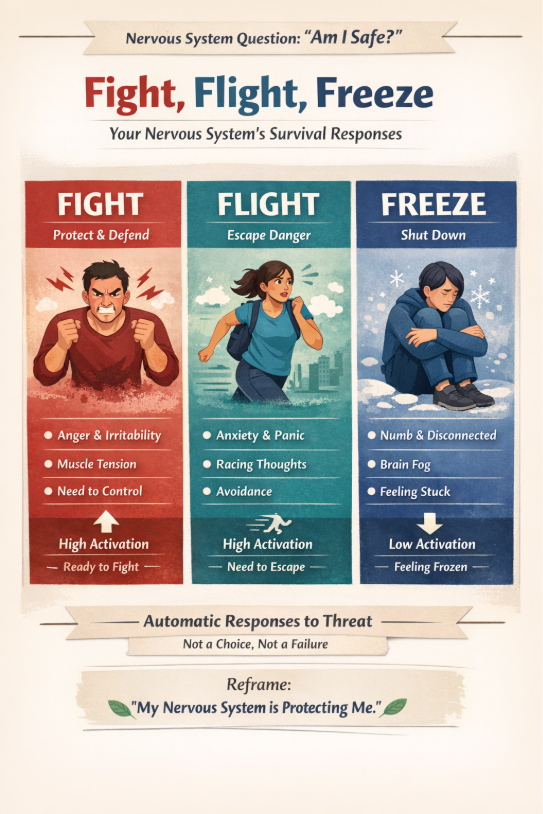
Fight, flight, and freeze are not personality flaws or signs of weakness. They are automatic survival responses rooted in the nervous system’s primary job: keeping you alive.
Understanding these responses is a powerful first step in building self-compassion, emotional regulation, and nervous system resilience.
The Nervous System’s Priority: Safety
Our autonomic nervous system is constantly scanning for safety or threat, often outside of conscious awareness. When it perceives danger, whether physical, emotional, relational, or even imagined, it mobilizes one of several protective responses.
These responses developed to help humans survive predators and life-threatening situations, but today they’re often activated by emails, conflict, deadlines, memories, traffic, or chronic stress.
Fight: Mobilizing Through Anger and Control
The fight response shows up as irritation, anger, defensiveness, or a need to control. The body prepares to confront the threat: heart rate increases, muscles tense, and adrenaline rises.
You might notice:
Snapping or yelling
Feeling easily frustrated or critical
A strong urge to “win,” argue, or prove a point
Fight isn’t about being aggressive, it’s about protecting boundaries when the nervous system believes they’re under threat.
Flight: Escaping the Threat
The flight response is driven by the urge to get away. The body mobilizes for escape, often creating restlessness, anxiety, or overwhelm.
You might notice:
Avoidance or procrastination
Busyness or overworking
Racing thoughts or constant worry
Flight often shows up in high-functioning people who appear “productive” on the outside but feel internally exhausted or unsafe slowing down.
Freeze: When the System Shuts Down
The freeze response occurs when fight or flight doesn’t feel possible. The nervous system conserves energy by shutting down.
You might notice:
Numbness or dissociation
Feeling stuck, foggy, or disconnected
Difficulty making decisions or taking action
Freeze is often misunderstood as laziness or lack of motivation, but it’s actually a protective response to overwhelm.
There’s Nothing Wrong With You
These responses are not choices, they’re reflexes. And many people cycle between them depending on context. Chronic stress or past trauma can make these patterns feel constant rather than situational.
Healing isn’t about eliminating fight, flight, or freeze. It’s about helping the nervous system learn that safety is possible in the present moment.
Practical Exercises to Support Each Response
For Fight: Slow the Exhale
Try extending your exhale longer than your inhale (inhale 4 counts, exhale 6–8). This signals safety and helps release excess activation.For Flight: Ground Through the Senses
Name 5 things you see, 4 you feel, 3 you hear, 2 you smell, and 1 you taste. This gently brings your system out of urgency and into the present moment.For Freeze: Micro-Movement
Instead of forcing action, start small. Wiggle your toes, press your feet into the floor, or slowly turn your head side to side. Movement helps thaw shutdown.For Any State: Orient to Safety
Look around and name objects that feel neutral or pleasant. Let your eyes rest on them for a few seconds to remind your nervous system that you are here and safe now.Build Awareness Without Judgment
When you notice a response, try saying: “My nervous system is protecting me.” This simple reframe can reduce shame and support regulation.
Understanding fight, flight, and freeze helps us recognize how our nervous system responds when safety feels compromised. But awareness is just the first step. In the next posts in this series, we’ll explore the window of tolerance, how it shapes our capacity to stay regulated, ways to expand that window over time, and why co-regulation is a vital part of nervous system health. Together, these concepts help move us from survival toward greater ease, flexibility, and connection.
Leanne Sudbeck, MSW, SWLC
References
Porges, S. W. (2011). The Polyvagal Theory: Neurophysiological Foundations of Emotions, Attachment, Communication, and Self-Regulation.
van der Kolk, B. (2014). The Body Keeps the Score: Brain, Mind, and Body in the Healing of Trauma.
Ogden, P., Minton, K., & Pain, C. (2006). Trauma and the Body: A Sensorimotor Approach to Psychotherapy.
Levine, P. A. (2010). In an Unspoken Voice: How the Body Releases Trauma and Restores Goodness.
Siegel, D. J. (2020). The Developing Mind (3rd ed.).