
Self-Regulation vs. Co-Regulation: Why We Need Both

Throughout this series, we've explored how the nervous system responds to stress, how our window of tolerance can expand, and why safe relationships help us regulate. One common misconception still remains: that emotionally healthy people should be able to regulate themselves without needing anyone else.
Many of us have heard messages like, "You need to calm yourself down,""Don't rely on other people," or "You should be able to handle this on your own." While learning self-regulation is an important part of emotional well-being, neuroscience tells us that it doesn't develop in isolation. In fact, healthy self-regulation begins with co-regulation.
What Is Self-Regulation?
Self-regulation is the ability to notice your thoughts, emotions, and physical sensations while responding intentionally rather than automatically. It allows you to pause before reacting, recover after stress, tolerate difficult emotions, and return to a balanced state (Siegel, 2020).
Examples of self-regulation include:
Taking slow breaths during a stressful conversation.
Using grounding techniques when anxiety rises.
Recognizing when you need rest before becoming overwhelmed.
Pausing before responding in anger.
Practicing self-compassion after making a mistake.
Self-regulation does not mean never becoming upset. It means being able to move through life's challenges without remaining stuck in survival mode.
Self-Regulation Is Learned Through Co-Regulation
Although self-regulation sounds like an individual skill, it develops through relationships.
Infants are not born with the ability to calm themselves. Their brains are still developing, particularly the areas responsible for emotional regulation, impulse control, and executive functioning. A caregiver's soothing voice, gentle touch, facial expressions, and consistent presence help regulate the infant's nervous system. Through thousands of these interactions, the child gradually learns to regulate independently (Schore, 2019; Siegel, 2020).
Dr. Louis Cozolino (2022) describes the brain as a "social organ," meaning it develops within relationships. Likewise, Stephen Porges' (2011) Polyvagal Theory explains that our nervous systems continuously detect cues of safety through connection with others. In other words, we borrow another person's regulation before we build our own.
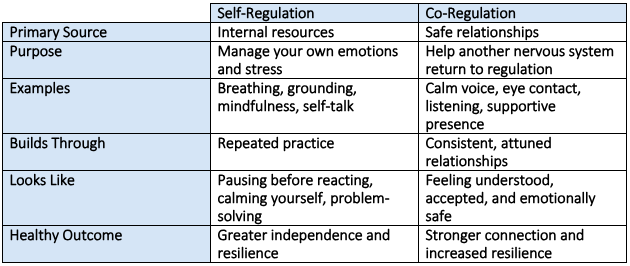
Self-Regulation Vs. Co-Regulation
Why Accepting Support Can Feel So Hard
If co-regulation is so natural, why do so many adults struggle to receive it?
The answer often lies in early experiences. If caregivers were inconsistent, emotionally unavailable, critical, or frightening, the nervous system may have learned that closeness was unpredictable or unsafe. Instead of expecting comfort during stress, it learned to rely on self-protection.
These protective strategies may look like:
Hyper-independence
Difficulty asking for help
Feeling uncomfortable when others are kind
Believing your needs are "too much"
Pulling away when relationships become emotionally close
These responses are not signs of weakness. They are adaptive strategies that helped someone survive earlier experiences.
When Safety Feels Unfamiliar
One of trauma's greatest paradoxes is that familiar does not always mean safe. If criticism, emotional distance, or unpredictability were common growing up, a calm, emotionally available relationship may initially feel uncomfortable. The nervous system often prefers what it predicts over what is objectively healthy because predictability itself feels safer than uncertainty (Levine, 2010).
Conversely, relationships that recreate old patterns may feel strangely familiar, even when they are unhealthy. This is not because people choose suffering. It is because the nervous system is trying to navigate the world using experiences from the past. The encouraging news is that nervous systems are capable of learning new patterns throughout life. Safe, consistent relationships can gradually reshape expectations about connection.
Healthy Interdependence Is Not Dependence
Sometimes people worry that accepting support means becoming dependent on others. Healthy co-regulation is different. Dependence means another person is responsible for regulating your emotions.
Healthy interdependence means two regulated people support one another while maintaining responsibility for their own thoughts, feelings, and behaviors. Think of it like hiking together. Each person walks on their own, but there are times when someone offers a steady hand over difficult terrain. Relationships work much the same way.
Self-regulation and co-regulation are not opposing skills; they are complementary. We strengthen self-regulation through mindfulness, grounding, movement, and self-awareness. We strengthen co-regulation through healthy relationships, supportive communities, and allowing ourselves to receive care. In some cases, therapy can also provide a structured space to experience safe co-regulation and build these skills over time.
The healthiest nervous systems are not those that never need others. They are those that can move flexibly between relying on internal resources and accepting support when needed. Healing is not about proving you can do everything alone. It is about knowing when to stand on your own and when to let someone walk beside you.
In the next post, we'll explore a question many people ask but struggle to answer: What does regulation actually feel like? You may be surprised to learn that regulation isn't the absence of emotion—it's something much more flexible and human.
Leanne Sudbeck, MSW, SWLC
References
Cozolino, L. (2022). The neuroscience of human relationships (3rd ed.). W. W. Norton & Company.
Levine, P. A. (2010). In an unspoken voice: How the body releases trauma and restores goodness. North Atlantic Books.
Ogden, P., Minton, K., & Pain, C. (2006). Trauma and the body: A sensorimotor approach to psychotherapy. W. W. Norton & Company.
Porges, S. W. (2011). The polyvagal theory: Neurophysiological foundations of emotions, attachment, communication, and self-regulation. W. W. Norton & Company.
Schore, A. N. (2019). Right brain psychotherapy. W. W. Norton & Company.
Siegel, D. J. (2020). The developing mind (3rd ed.). Guilford Press.